DSCR Loan California Investor Guide (2026): Qualify on Rental Income, Not Tax Returns
Everything California real estate investors need to know about DSCR loans in 2026 — how the math works, what lenders require, which markets produce the strongest ratios, and how to close in 21 days without a single tax return.
What Is a DSCR Loan?
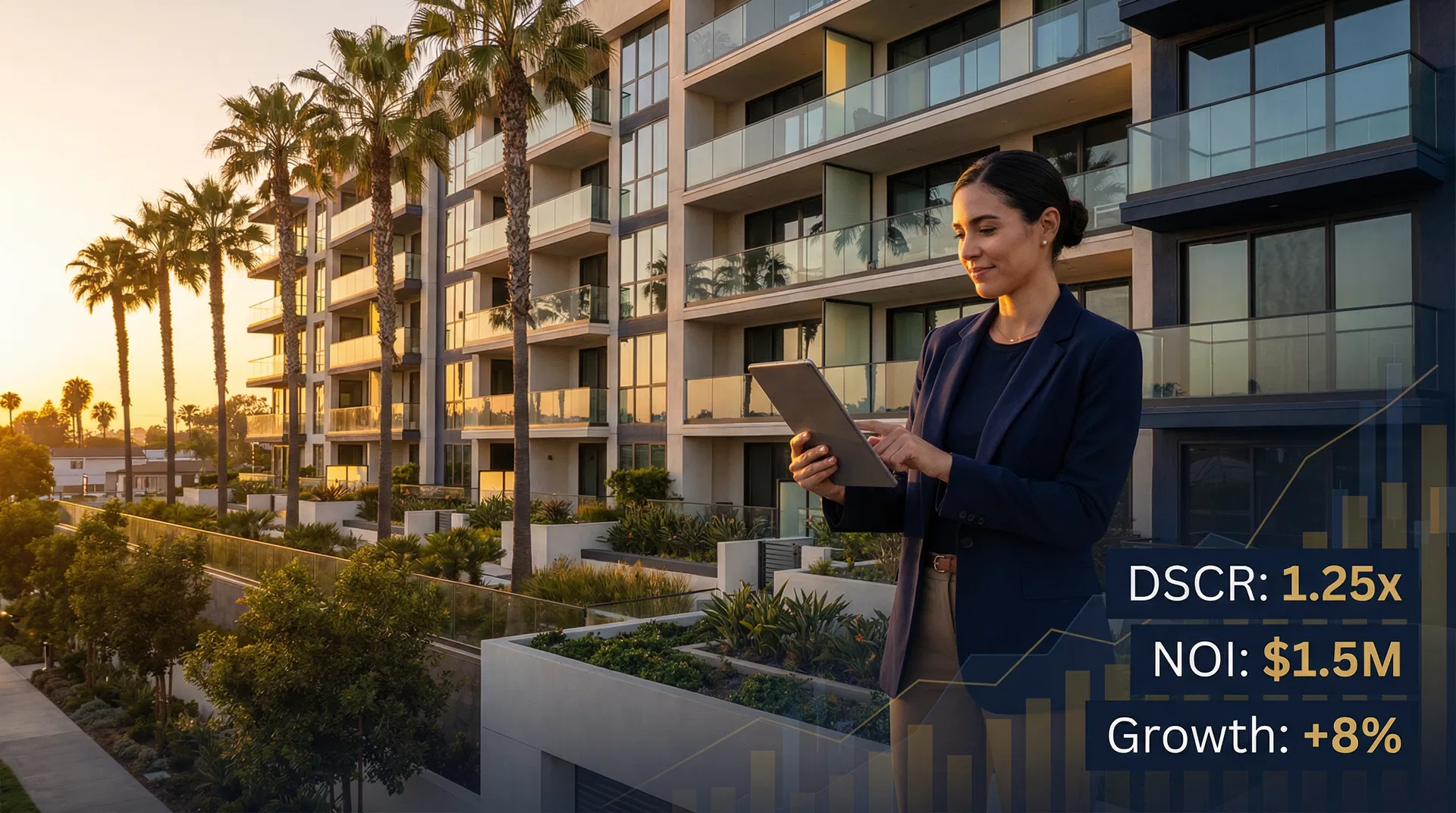
DSCR stands for Debt Service Coverage Ratio. It is a single number — the ratio of a property's gross rental income to its total annual debt obligations — and it is the only income metric that matters for this type of loan.
The formula is straightforward:
DSCR = Annual Gross Rental Income ÷ Annual Debt Service
Annual Debt Service = Principal + Interest + Property Taxes + Insurance + HOA (if applicable)
A property generating $54,000 per year in rent with $42,000 in annual debt service has a DSCR of 1.29. That single number tells the lender everything they need to know about whether the property pays for itself — and your personal W-2, tax returns, and employment history never enter the equation.
This is the fundamental difference between DSCR financing and every other mortgage product: the property qualifies, not you personally.
How DSCR Loans Work in California
California's rental market is structurally well-suited to DSCR financing. With a statewide vacancy rate of approximately 4.1% and 45.4% of residents renting rather than owning, the cash flow that DSCR programs require is consistently available across a wide range of markets and price points.
DSCR loans in California are non-owner-occupied investment property loans only. You cannot use them for a primary residence or a second home you plan to occupy. That restriction is what allows lenders to underwrite based on business fundamentals — the property's income performance — rather than personal housing regulations.
The loan process itself is streamlined compared to conventional financing. Lenders order a rent survey or review the existing lease to establish income, run a standard appraisal, verify your credit and assets, and confirm the DSCR calculation. There is no employment verification, no income tax analysis, and no DTI calculation. For investors who have spent years watching conventional lenders penalize them for depreciation deductions and pass-through losses, the simplicity is striking.
DSCR Loan Requirements: What California Investors Need to Qualify
Requirements vary by lender and program, but the parameters below reflect what you will encounter from reputable non-QM lenders in 2026.
| Requirement | Typical Range |
|---|---|
| Minimum DSCR | 0.75 – 1.00 (varies by program) |
| Optimal DSCR (best pricing) | 1.25+ |
| Minimum credit score | 620 – 660 |
| Credit score for best LTV/rate | 700+ |
| Maximum LTV (purchase) | 75% – 80% |
| Maximum LTV (cash-out refi) | 70% – 75% |
| Minimum loan amount | $150,000 |
| Maximum loan amount | $3M – $5M (jumbo programs available) |
| Eligible property types | SFR, 2–4 unit, condo, townhome |
| Short-term rentals (Airbnb/VRBO) | Eligible with STR income documentation |
| LLC vesting | Permitted on most programs |
| Reserve requirement | 2 – 6 months PITIA |
One important nuance: a DSCR below 1.0 does not automatically disqualify you. Many programs accept ratios as low as 0.75, meaning the property covers 75% of its debt service, provided you bring a larger down payment (typically 25–30%) and have a stronger credit profile. At 1.0, the property breaks even. At 1.25 and above, you unlock the best rates and the highest LTV options.
What Documentation Is Actually Required?
The documentation list for a DSCR loan is notably shorter than a conventional mortgage package:
- Executed lease agreement (for occupied properties) or a professional rent survey (for vacant properties)
- Standard appraisal with rent schedule
- Bank statements showing down payment and reserves
- Credit report
- Entity documents if vesting in an LLC or corporation
No tax returns. No W-2s. No pay stubs. No employer verification letters.
DSCR Loan Rates in California (2026)
As of early 2026, DSCR loan interest rates for qualified California borrowers range from approximately 5.875% to 7.375%, a meaningful improvement from the 8–9% range that prevailed through much of 2023 and 2024. The rate you receive depends on your DSCR ratio, credit score, LTV, property type, and whether you are using short-term or long-term rental income for qualification.
Rates on DSCR loans are typically 0.5–1.5% higher than comparable conventional investment property loans, reflecting the no-income-documentation structure. For most California investors, that premium is a straightforward trade-off: the ability to close without tax returns, qualify without DTI limits, and hold properties in an LLC is worth the incremental cost.

Get a Free Rate Quote
Tim Storm · Mortgage Advisor · Arbor Financial Group
No credit pull · Response within 1 business hour
The Best California Markets for DSCR Investing in 2026
Not all California markets produce DSCR ratios with equal ease. The relationship between purchase price, achievable rent, and debt service varies significantly by region.
Orange County: Reliable Cash Flow and Tenant Stability
Orange County has become one of the most active DSCR markets in Southern California. Investors in cities such as Anaheim, Orange, Costa Mesa, and Garden Grove consistently find properties where rental income meets or exceeds DSCR thresholds. The tenant base is unusually stable — strong household incomes, low unemployment, and a job market anchored by healthcare, technology, and professional services. Year-over-year rent growth has been steady at 2–3%, and vacancy rates run below the statewide average.
The Inland Empire: California's Cash Flow Capital
If maximizing the DSCR ratio is the primary goal, the Inland Empire — Riverside, Moreno Valley, Corona, Murrieta, Temecula — consistently outperforms every coastal market in Southern California on pure return metrics. Purchase prices remain well below coastal comparables while rental demand has grown substantially as workers priced out of Los Angeles and Orange County have relocated inland. Cap rates in the Inland Empire range from 5% to 7.5%, compared to 3–4% in coastal Orange County.
San Diego: The Short-Term Rental Opportunity
San Diego is one of the top-performing short-term rental markets in the United States, driven by year-round tourism, a large military population generating mid-term rental demand, and a robust tech and biotech workforce. Short-term rental income in San Diego can significantly exceed long-term rental figures, making DSCR qualification easier than the purchase price alone might suggest. Neighborhoods such as Pacific Beach, Clairemont, and North Park generate exceptional DSCR potential.
Los Angeles: Scale and Diversity
Los Angeles remains one of the strongest rental markets in the country by volume, with high rents, constant population movement, and a massive short-term rental audience in legally permitted zones. Neighborhoods such as North Hollywood, Silver Lake, Mid-City, and West Adams frequently produce DSCR ratios that meet program thresholds despite the city's high property values.
Short-Term Rentals and DSCR Loans
One of the most significant expansions in DSCR lending over the past two years has been the growing acceptance of short-term rental income for qualification purposes. Many non-QM lenders now allow investors to use Airbnb and VRBO income — documented through platform statements or a professional STR income analysis — to establish the DSCR calculation.
This matters enormously for California investors. In markets like San Diego's beach communities, Palm Springs, and Big Bear, short-term rental income can run 40–80% higher than the equivalent long-term lease rate. A property that would produce a marginal 1.05 DSCR on a long-term lease might generate a 1.45 DSCR when underwritten on verified STR income.
Portfolio Scaling: Why DSCR Loans Are Built for California Investors
Conventional financing limits most borrowers to 10 financed properties. DSCR loans carry no such restriction. Each property qualifies independently based on its own cash flow, which means your third, fifth, or tenth acquisition does not affect the underwriting on any of the others.
This structural feature is what makes DSCR financing the preferred tool for California investors who are actively building portfolios. You can close a property in Riverside without it affecting your ability to close another in Orange County three months later. You can hold properties in separate LLCs for liability protection without losing access to financing. And you can refinance existing rentals into DSCR loans to free up conventional loan capacity for other purposes.
The reinstatement of 100% bonus depreciation under federal legislation in 2025 has added another dimension to this calculus. Investors who aggressively depreciate their California rental properties — which often reduces their reported taxable income significantly — no longer need to worry that those deductions will disqualify them from financing. The DSCR loan simply does not look at that number.
Common Questions About DSCR Loans in California
Can a first-time investor use a DSCR loan? Yes. There is no requirement for prior investment property ownership. As long as the property meets the income requirements and you meet the credit and asset standards, first-time investors can qualify.
Can I use a DSCR loan to refinance a property I already own? Yes, including cash-out refinances. Many California investors use DSCR cash-out refinancing to pull equity from existing rentals and redeploy it into new acquisitions.
Can I hold the property in an LLC? Yes. Most DSCR programs allow — and some prefer — entity vesting. This is one of the meaningful advantages over conventional financing, which typically requires individual ownership.
How long does it take to close? With complete documentation, most DSCR loans close in 21 days or less.
What if my property is currently vacant? Lenders use a professional rent survey or comparable rental analysis to establish the market rent for the DSCR calculation. A vacant property is not automatically disqualifying.
Ready to Run the Numbers on Your Next California Investment Property?
Tim Storm at Arbor Financial Group has spent 35 years closing non-QM loans for California real estate investors. If you are evaluating a DSCR loan for a California investment property — whether it is your first rental or your fifteenth — call (949) 829-1846 or complete the form below for a no-obligation consultation.
*NMLS #223456. This article is for informational purposes only and does not constitute a commitment to lend. Loan programs, rates, and guidelines are subject to change without notice. Not all borrowers will qualify.*
Ready to Get Pre-Qualified?
Tim Storm · Mortgage Advisor · Arbor Financial Group
No credit pull · Response within 1 business hour
35 years closing non-QM loans for California's self-employed borrowers, investors, and high-net-worth clients.
(949) 829-1846